High-chair quality guide
How to Judge a High Chair: Materials, Stability, Cleaning and Everyday Quality
A high chair earns its place through hundreds of ordinary meals. Learn how to read the materials, structure, care details and daily ergonomics behind a polished product photo.
Quality is a system, not a single material
A high chair can look simple because its job is familiar: elevate a young child for meals. In practice, it is a compact system of load-bearing parts, moving adjustments, food-contact surfaces, soft components and restraints. Quality appears in the way those parts work together. A handsome hardwood leg does not compensate for a tray that is awkward to remove, just as a feature-rich frame does not help if crumbs collect in places that cannot be reached. The useful question is not whether one material sounds premium. It is whether the complete chair supports a stable, repeatable routine.
Begin by separating structural materials from touch surfaces. Legs, cross supports and joints control the chair’s stance. The seat shell, tray and footrest shape the child’s position and the caregiver’s workflow. Cushions and covers affect comfort, but they also introduce seams, attachment points and care instructions. Wheels, folding hinges and height mechanisms add mobility while creating more parts that must lock positively. Reading the chair in layers makes comparison clearer and prevents one attractive feature from dominating the decision.
The United States Consumer Product Safety Commission maintains a mandatory safety standard for high chairs at 16 CFR part 1231. That standard is a manufacturer and importer obligation, not a shopping badge that can be inferred from appearance. A responsible shopper can still use the regulatory framework as a reminder that stability, restraint performance, openings, locking mechanisms and warnings matter. Product instructions, registration information and current recall status deserve the same attention as color and silhouette.
| Material or component | What it can do well | What to inspect | Care question |
|---|---|---|---|
| Hardwood legs and braces | Provide a warm appearance and a direct structural path when the geometry is well designed | Joint fit, cross supports, hardware seating, finish consistency and any movement after assembly | Which cleaners are permitted, and should standing moisture be avoided? |
| Metal or engineered frame parts | Support folding, height changes and compact mechanisms | Lock engagement, exposed pinch areas, fastener tightness and whether the frame rocks on a level floor | Can spills reach a hollow tube, hinge or wheel housing? |
| Molded polymer tray or seat | Create smooth shapes, removable layers and easy-wipe surfaces | Edges, flex, attachment points, tray travel and the exact food-contact or care statement | Is the removable layer actually listed as dishwasher-safe? |
| PU or leatherette cushion | Offer a smooth wipe-clean face and a softer seated surface | Seams, harness slots, underside attachment, creasing and places where liquid can migrate | Does it remove, and what does the instruction say about soaking or detergents? |
| Textile pads and straps | Add comfort and secure fit | Stitching, webbing path, buckle operation, label legibility and whether pieces can twist | Can each piece be removed and fully dried before reassembly? |
Material names describe ingredients or surface types. They do not, by themselves, establish durability, safety certification or ease of care.
Read the structure from the floor upward
A stable-feeling chair begins with its footprint. Look at how far the legs spread, where the child’s weight sits relative to that base and whether cross members resist racking from side to side. A wide stance can increase the room a chair occupies, so measure the actual path around the table rather than judging from a front-facing photo. Include the chair pulled away for loading and the space needed for an adult to operate the tray. A product can fit beneath a tabletop yet still interrupt the busiest walkway in the kitchen.
Assembly quality matters because many high chairs arrive in sections. Follow the supplied sequence, use every specified brace and do not substitute hardware. Tighten connections as directed, then place the chair on a level surface and check for rocking before the first use. Recheck fasteners according to the manual and after moving or converting the chair. If a component will not align without force, stop and resolve the mismatch instead of using the seat with an incomplete support.
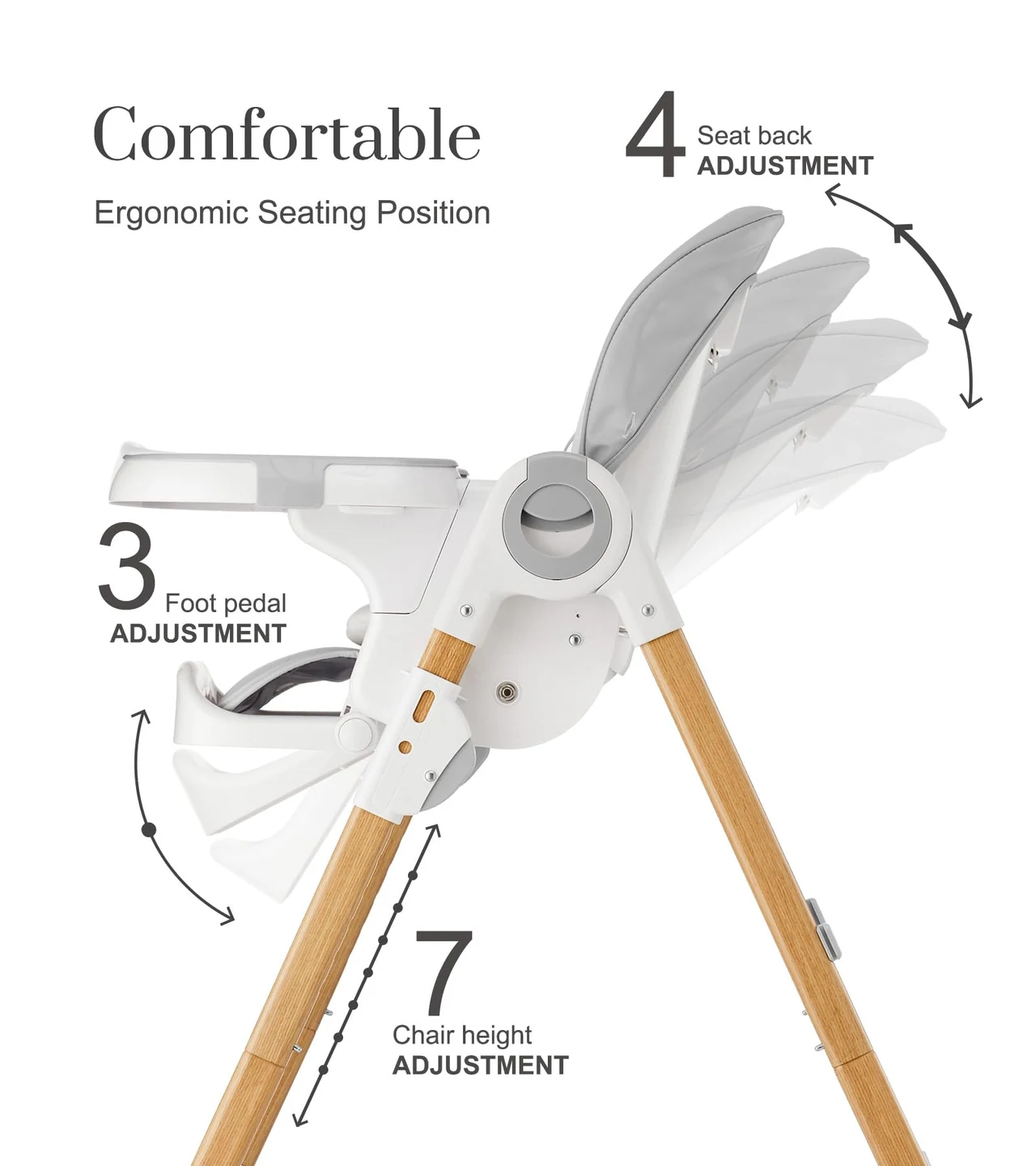
Adjustability changes the inspection. A folding frame should communicate clearly when it is fully open. Height, backrest and footrest positions should settle into their intended detents rather than hovering between settings. Wheels should be used only as the instructions allow, and any brakes or fixed positions should be engaged before seating a child. More adjustment points can make a chair fit more situations, but each point becomes part of the setup checklist.
The restraint is not an optional accessory. Examine how the shoulder, waist and crotch portions route through the seat, how the buckle releases and how easily slack can be removed. Straps should lie flat rather than twist. The tray is not a substitute for the restraint system. Keep the harness assembled as instructed even when the child appears calm or the meal is brief. A consistent sequence—chair stable, locks engaged, child seated, restraint adjusted—reduces improvisation.
Finally, consider behavior around the chair. Siblings may lean on it, adults may hang bags from it and a mobile chair may be pushed while occupied even when that use is not intended. Quality shopping includes planning against those predictable shortcuts. Keep climbable objects away, avoid adding unapproved accessories and place the chair where an adult can supervise without turning the seat into a barrier between the kitchen and dining area.
Fit is about the child, table and caregiver
A chair is used by a child but operated by an adult, so both bodies matter. For the child, review the manufacturer’s age, size and developmental guidance and make sure the current seated posture matches the intended use. For the caregiver, notice how far you must bend to place the child, reach the buckle and wipe the seat. A tray that removes with one hand may be helpful only if the other hand can remain on the child and the release cannot be activated accidentally.
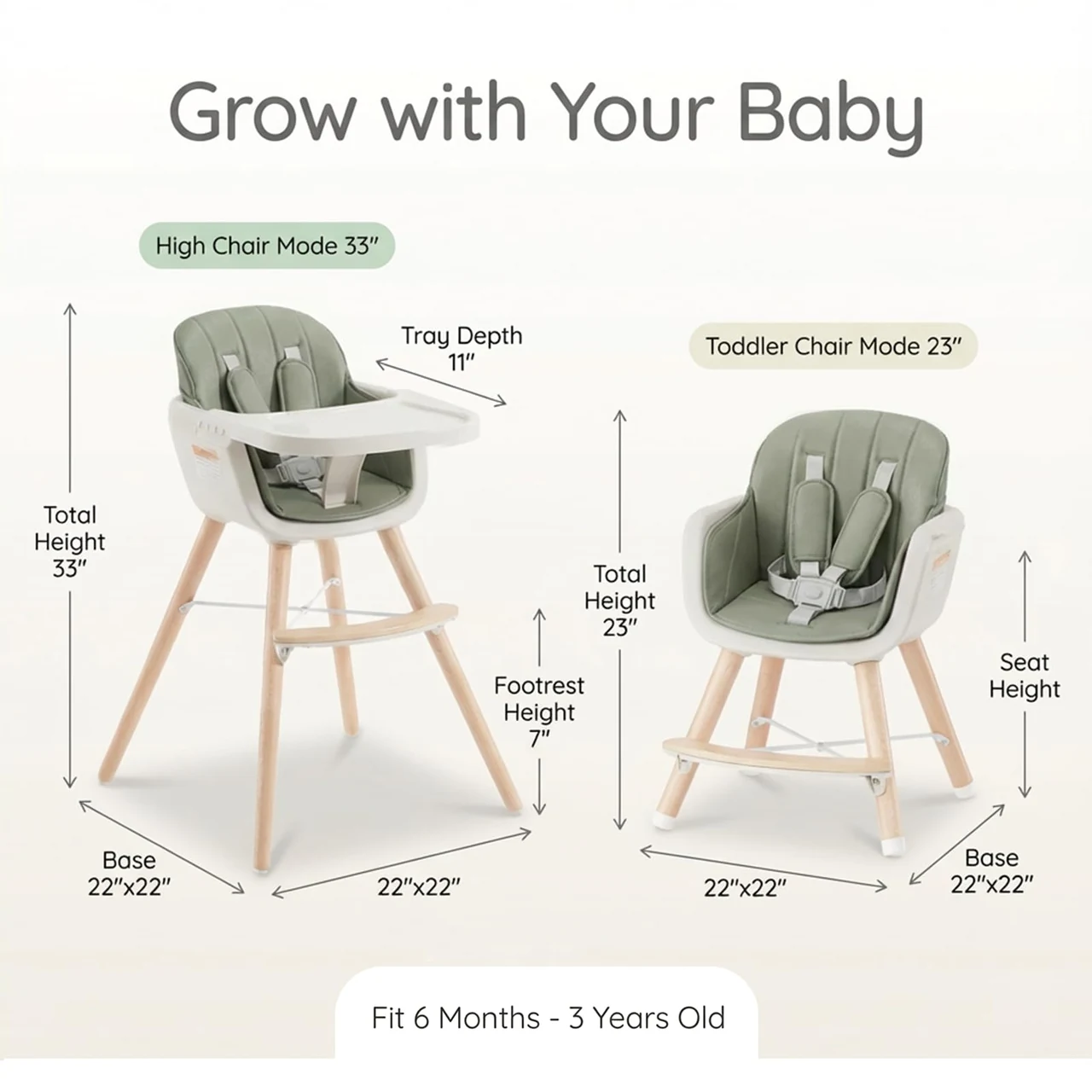
Table relationship is another practical test. A fixed-height chair may be visually quiet and predictable, while a height-adjustable chair can meet several surfaces. Measure the tabletop, apron and nearby furniture. If the chair is intended to roll between rooms, measure doorways and turns as well as the storage location. If it folds, confirm the folded dimensions and whether it stands, leans or must be placed flat. Storage marketing is meaningful only when the folded object has a safe home.
Foot support deserves deliberate attention. The goal is not to force one posture or make a medical claim; it is to compare the chair’s adjustment range with the product’s own guidance and the child’s current dimensions. Check whether the footrest can be positioned without creating a step that invites climbing. Revisit the position as the child grows, and never extend use beyond the stated limits simply because another setting remains available.
Tray depth affects reach and cleanup. Multiple tray positions can help place the surface appropriately, but they must lock as designed. Slide the tray through its full path before the first meal and learn where fingers should be kept during adjustment. If there is a removable upper tray, confirm how it separates and whether the lower layer remains suitable for the activity shown in the instructions. Do not interpret a removable liner as permission to place every tray component in a dishwasher.
Caregivers also need a clear release routine. Practice opening the buckle, removing the tray and folding or moving the empty chair before using it with a child. The best mechanism is one that feels unambiguous after repetition. If several adults use the chair, show each person the same order of operations. A concise routine posted mentally is more valuable than a long list of features nobody remembers during a rushed breakfast.
Cleaning quality is designed into the seams
Food changes the way a product ages. Smooth surfaces are helpful, but the important details are transitions: tray to seat, cushion to shell, strap to slot and hardware to frame. Inspect gallery close-ups for creases and recessed fasteners. Imagine a sticky liquid traveling downhill. Where does it stop, and can that area be reached without disassembling a structural connection? The most practical design is not always the one with the fewest visible lines; it is the one whose lines can be cleaned and dried as directed.
Build a two-level routine. After each meal, remove loose food, wipe permitted surfaces and deal with spills before they migrate. At the interval recommended by the manufacturer, inspect under removable pieces, clean straps and check joints. Use only products and temperatures allowed by the care instructions. Stronger chemicals, abrasive pads and soaking can damage finishes or labels even when they seem faster in the moment.
A dishwasher-safe statement must attach to a specific part. On a layered tray, the top insert may have different directions from the base. A wipe-clean cushion may not be machine washable. A removable harness may require hand washing and complete air drying. Treat each component as its own material system and keep the instructions available. If the listing and manual differ, pause and seek current product-specific guidance before experimenting.
Drying is part of cleaning. Moisture trapped beneath a pad or around hardware can create odor, staining or finish problems. Reassemble only when components are fully dry and routed correctly. Confirm that cleaning did not loosen a buckle, twist a strap or leave a tray latch obstructed. This final inspection turns care from a cosmetic task into a functional one.
| If your routine includes… | Prioritize… | Verify before checkout |
|---|---|---|
| A fixed dining spot and a preference for furniture-like lines | A stable stance, straightforward conversion and easy-access hardware | Exact footprint, included braces, tray positions and finish-care directions |
| Several table heights or caregivers of different heights | Seat-height adjustment with clear locking positions | Adjustment range, lock operation and whether changes are permitted while occupied |
| Moving the empty chair between rooms | Manageable weight, wheel behavior or a secure folding method | Doorway fit, brake instructions, folded storage and rules for moving the chair |
| Frequent messy meals | Removable food-contact layer, reachable seams and wipe-clean surfaces | Which tray layer is dishwasher-safe and how straps and cushions are cleaned |
| Limited floor space | A measured footprint and a realistic storage plan | Open and folded dimensions, standing behavior and the clearance needed to operate the chair |
The correct priority is the one you will use consistently, not the feature with the largest number on a comparison chart.
Durability comes from inspection and disciplined use
Durability is not a promise that a chair can absorb every shortcut. It is the combination of appropriate materials, sound construction, correct assembly, routine cleaning and use within stated limits. Keep the model and purchase information. Register the product when registration is offered, retain the manual and review safety notices. If a structural part cracks, a restraint no longer adjusts, a wheel will not lock or a fastener repeatedly loosens, stop using the chair until the issue is resolved through the appropriate product-support route.
Watch high-contact areas. Tray latches, buckle tongues, harness webbing, cushion seams, footrest supports and folding locks experience repeated motion. A quick visual and tactile check before seating a child can reveal food obstruction, fraying or incomplete engagement. Do not repair load-bearing or restraint parts with improvised tape, replacement screws or accessories that were not specified for the model.
Conversion features need their own instructions. A chair described as convertible may become a lower chair, stool or another configuration, but each mode has a defined assembly and intended user. Store unused hardware together and label it. Re-read the relevant section before converting instead of relying on memory. After the change, repeat the level-floor stability check and confirm that no attachment from the previous mode remains partially engaged.
A quality purchase decision therefore looks modest: measure, read, assemble carefully, practice the mechanisms and clean according to component-specific directions. Those steps do more for daily satisfaction than a vague premium label. They also make differences between chairs visible. The Mallify wood and adjustable designs can then be compared on the routines they support rather than on styling alone.
A 10-minute high-chair quality check
- Confirm the exact selected model, color, included parts and current instructions.
- Measure the open footprint, table relationship, caregiver path and storage location.
- Identify every structural brace, fastener and lock used in the intended configuration.
- Place the fully assembled empty chair on a level floor and investigate any rocking.
- Operate the tray, buckle, height, backrest, footrest, wheels and fold before first use.
- Read care directions separately for the tray layers, cushion, straps, frame and finish.
- Locate the model information, registration route and CPSC recall search.
- Plan where removable parts will be washed, dried and stored.
- Teach every caregiver the same setup, restraint and release sequence.
- Stop use if a structural, locking or restraint component is damaged or unreliable.
Choose the chair you can use correctly every day
High-chair quality is visible in ordinary moments: the frame remains settled while the tray is adjusted, the restraint lies flat, a spill can be reached, and the empty chair moves or folds only as intended. Materials matter because they shape those moments. Hardwood, polymers, metal mechanisms, PU surfaces and textile webbing each bring strengths and maintenance needs. The best combination is the one that remains understandable after the product has left the box and entered a busy room.
Use photographs to study construction, but let measurements, instructions and verified component details lead the decision. Compare the fixed, wood-forward Mallify chair with the adjustable wheeled model according to your floor plan and routine. Confirm the selected listing again before checkout because included parts and availability can change.
This guide is general shopping and care information, not a substitute for the product manual, current safety notices or professional advice. Follow the instructions supplied with the exact chair, use the restraint every time and keep active supervision at the center of the meal.
Further reading
Primary and professional sources
These sources provide general regulatory, developmental or safety context. The instructions for the exact product remain controlling.
Keep reading
More from the Mallify journal
Floor-play quality guide
Baby Play Mats and Gyms: A Material, Washability and Quality Guide
The best play space is not the one with the longest feature list. It is the one whose surface, structure, care routine and stage fit make supervised awake play easier to repeat.
Read the guide
Hands-on learning guide
Choosing a Preschool Busy Book: Materials, Reusability and Meaningful Play
A busy book works best when the materials survive repetition, the activities match the child and the adult knows how to turn matching, tracing and drawing into a real conversation.
Read the guide